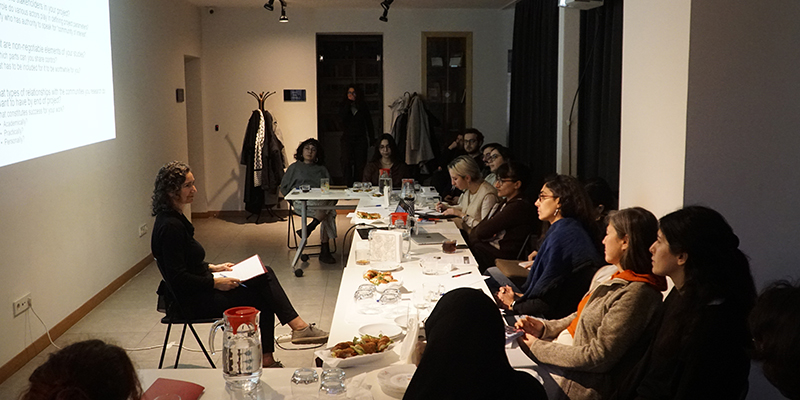
The workshop titled “Collaborative Methodology as Part of Research Design,” led by Associate Professor of Political Science Dr. Mneesha Gellman, was held on February 25, 2026 at the Anarad Hığutyun Building in Istanbul.
Designed for researchers and practitioners, the two-hour workshop explored how collaborative methodologies can be integrated into research and project design. Drawing on examples from her fieldwork conducted for her 2025 book Learning to Survive: Yurok Well-Being in High School, Gellman discussed the ethical dimensions, challenges, and possibilities of working with rather than on research participants.
In her presentation, based on multi-method and comparative research conducted with the Yurok Tribe in Northern California, Gellman addressed how collaborative methodologies offer an alternative to historically extractive research practices in academia. She emphasized the relevance of this approach, particularly for studies involving historically disadvantaged and marginalized communities.
Throughout the workshop, participants reflected on their own research and project processes, engaging with questions such as who the stakeholders are, how decision-making processes are shaped, who holds authority and the right to represent, and how responsibility and power are shared within research. The discussion also addressed how success can be defined both academically and personally, as well as what kinds of relationships researchers aim to build with communities by the end of a project.
The workshop, attended by 13 participants, mostly graduate students from various universities in Istanbul, provided a space for participants to exchange ideas and experiences around collaborative research practices.