
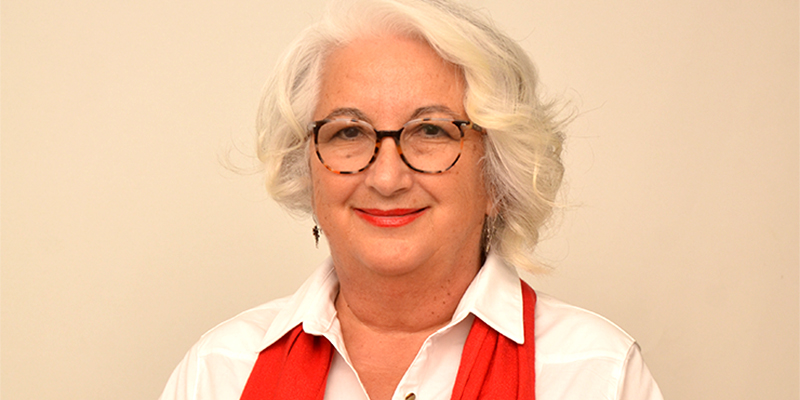
She was born in the Erbaa district of Tokat in 1957. She attended elementary and middle school in Erbaa and completed high school at Robert College. She received a degree in construction engineering from the Middle East Technical University (ODTÜ) and worked as a port engineer after graduation. In 1987, she moved to Antalya and played a key role in founding and managing the ODTÜ Alumni Association, the Antalya Women's Consultancy and Solidarity Center, and the Antalya Contemporary Education and Cultural Foundation.
Shortly after retiring in 2002, she settled in the Nusratlı village, located on the slopes of Kazdağları (Mount Ida). She led the establishment of the Culture, Tourism and Solidarity Association of Nusratlı Village and conducted important work with women on rural development.
In 2007, she organized the campaign in Bahçedere village against the gold-prospecting drilling, which resulted in the project's termination. That same year, she spearheaded another notable environmental movement as part of the Protection of Kazdağı Initiative and continued it through the Kazdağı Association for the Preservation of Natural and Cultural Resources, founded in 2012. She became a co-spokesperson for the Ecology Union upon its establishment in 2017.
She was on the front lines of the "Water and Conscience" vigil against the Doğu Biga Mining Company–the local subcontractor for Alamos Gold–and actively participated in the entrenched resistance in 2019. The campaign drew significant public attention, documented the damage inflicted on nature, and led to mass demonstrations involving tens of thousands of people. As a result, the company failed to renew its permit and had to leave the region.
Following this victory, she participated in COP26 in Glasgow in 2021 and took part in creating the Climate Justice Coalition upon her return to Türkiye. She is currently contributing to the organization of People's Climate Summit Beyond COP31.
The association she chairs has successfully garnered public support and brought more than a hundred lawsuits that resulted in the annulment of energy and mineral prospecting projects, as well as related laws and regulations.
Her struggle quickly placed her in the crosshairs of the government and various interest groups. A residential development company filed charges against her because of her successful attempt to cancel the construction of 200 luxury villas on the Akçay wetlands. She became the target of defamation campaigns intended to bring her good name into disrepute. Her campaign against the development of this water basin prompted public authorities to scrutinize her organization. She was fined on the charges that she had violated her association's bylaws by sending boots as humanitarian aid to children affected by the Ayvacık earthquake. In court proceedings some penalties were reduced and others were dropped.
She was investigated again in 2023 for protesting the cancellation of the Bayramiç "Ecofest" event. She was acquitted at the end of a three-year trial.
Her rigorous protests continued into 2025. She denounced the sponsorship of the "Water Summit" in Çanakkale by gold mining companies, declaring, "The mining companies that contaminate and destroy water resources cannot sponsor Water Summit." She was forcefully removed from the meeting hall. She was seized by her arms and gagged as she was escorted off the stage without her walking stick despite her recent knee surgery.
She has been one of the founders and technical facilitators of the Women's Convention, while also actively participating in the struggle against murder and violence targeting women around the Edremit Bay area under the banner of Bay Area Independent Women's Solidarity.
As a member of EŞİTİZ, she organized online thematic meetings throughout the Covid-19 pandemic. Since 2020, she has been actively involved in coordinating the Women's Platform for Equality (EŞİK)
For refusing to give up defending the Kazdağları region and all its natural and cultural resources, striving to improve women's human rights, vocally challenging state-sponsored ecocide projects, and promoting the right to coexist with nature, the 2026 International Hrant Dink Award laureate is Süheyla Doğan.
Dear friends, good evening.
When dear Rakel Dink called me and told me that she wanted to inform me personally that I was the recipient of this year's International Hrant Dink Award, it was one of the most important and exciting moments of my life. It is truly difficult for me to put into words the joy and pride I felt.
First and foremost, I would like to thank the Hrant Dink Foundation and dear members of the jury for considering me worthy of this honour.
And, I acknowledge that accepting this honour brings a profound sense of responsibility… Before all of you, I make my promise: For the rest of my life, I will strive to remain worthy of this award and I will uphold the principles and values Hrant Dink defended. I will continue to stand for peace, justice, equality, human dignity, and the right to life.
We all know that, in life, it is not only our own choices that determine who we are and what we believe in. There are other people who touch our lives and shape who we are with their teachings…There are those who stand right beside us, those who challenge us, those who give us courage, and sometimes those who show us that another world is possible simply through their existence. Today, as I stand here receiving this award, I carry them within me too…
If I may, I would like to take a moment to acknowledge some of them here and thank them.
- The woman who never had the opportunity to go to school, yet had a very sharp mind and a remarkable memory; who always had a positive attitude towards life; who protected and looked after the best interests of her children, relatives, and neighbours; who sent her children to boarding schools at a young age–some of them even abroad–yet shed her tears only behind the closed doors so as not to upset them; the yörük woman who is the inspiration for my love for highlands, mountains, and the nature: My beloved mother Hatice Doğan, whom I lost during the pandemic,
- The man who grew up in an impoverished family in Erbaa's Zilhor village without a father; who lost his siblings in the Erzincan earthquake; who managed to attend the Ladik Village Institute after primary school through his own efforts and started teaching when he returned to his village; who later trained countless students by teaching at middle and high schools; who was exiled by the Nation Front government yet never gave up; who painted, played the ud, wrote many articles and books; who held my hand and took me to the exams that led me to studying at such a prestigious school as Robert College; who I know had always thought of me, and looked out for me: My beloved father Hayri Doğan,
- My dear older brother Numan and younger brothers Tahir and Bilge, whose support, regard, and care for me I have always felt.
- The apple of my eye, my dearest daughter Zeynep, who showers me with her love and from whom I have learned so much; my beloved grandson Toprak, who has given me the joy of being a grandparent and who, like me, has a great love of the colour red.
- My beloved Duman, with his gentle and melancholic eyes, loyalty and love; whom I had lived with for 16 years before he passed away 10 years ago and brought inconsolable tears to my eyes; but who now rests and has reunited with life beneath the walnut tree in our garden.
- My close family: beloved Derya and Deniz, who have always been the source of my joy for life and are always been on my mind; Gülsüm, whose supporting hand I have always felt on my shoulder; Erdem; who nourishes my soul with his songs; and Nabi, who has always made me feel special through his reaffirmation, 'You have a special place.'
- My dear partner for life, my equal, my beloved, poet and writer Mecit Ünal, who has nourished me, strengthened me, supported me with his artistic spirit, perspective on life and love, and stood by my side through everything.
- The METU Alumni Association, which became an academy for me during my years in Antalya and the venue for our Tuesday Conversations, also joined by my dear friend Bülent Şık, a laureate of last year's International Hrant Dink Award; as well as the Antalya Contemporary Education and Culture Foundation, which I co-founded and which has since become a home to many young people.
- An irreplaceable network that I have been part of since its foundation and that has helped shape the Women's Movement in Turkey; a platform that has met every Wednesday without interruption for 328 weeks, standing up for the rights of women and LGBTI+ people and declaring, 'We Will Not Give Up Our Rights, Our Lives or Our Dreams'; a community where I feel safe and where I have learned so much from each and every of its members: The Women's Platform for Equality - EŞİK,
- Lawyer Hülya Gülbahar, who has taught me about determination, courage, and sisterhood and nourished me with her knowledge and wealth of experience in women's human rights.
- My dear sister Sevim, who is the embodiment of sharing, and my friend and little sister, butterfly Zeynep.
- My dear neighbour Meryem, an extraordinarily generous woman always willing to share, who taught me the secrets of rural life; who is the true owner of our garden; whose stuffed squash blossoms I adore.
- My beloved association, which, together with each and every one of its members and volunteers, has worked with passion and determination for the past 18 years to protect Kazdağı and its surroundings, and of which I am proud to be a member; Kazdağı Association for the Protection of Natural and Cultural Heritage.
I extend my gratitude and heartfelt thanks to all my friends, relatives, and civil society organisations whose names I have not been able to mention, yet who have enriched me, equipped me, and empowered me throughout the years.
As a country, we are going through an extremely difficult period. The ecological destruction, rights violations, anti-democratic and fascistic practices have rendered our lives unbearable.
The government's mining policy has turned every corner of our country, its mountains, forests, agricultural lands, and habitations into areas that can be exploited for profit. While only 1000 mining licenses had been issued in total before the AKP came to power in 2002, more than 400.000 mining licenses have been issued since 2002. 79 percent of Kazdağları has been licensed for drilling. The situation in other regions is not all that different. Despite days of resistance by local people, through rain and snow, the drilling rigs entered the Perşembe Plateaus following a harsh intervention by the law enforcement units. Kazdağları, Madra Mountain, and all the mountains of my country are weeping tears of blood.
The same goes for energy policy. Sadly, in our country—which is a party to the Paris Agreement and will host the COP 31 Climate Summit, bringing together countries expected to develop solutions to the climate crisis—permits are still being granted for coal-fired thermal power plants.
The Environmental Impact Assessment process has been initiated for the second unit of the Cenal Power Plant in Çanakkale, which will run on imported coal once operational. Olive groves in Akbelen and surrounding villages are being expropriated to supply coal for the Yatağan, Yeniköy, Kemerköy thermal power plants that plague life in Muğla. Furthermore, new coal-fired power plants are being commissioned in Afşin, Elbistan. Under the banner of 'renewable energy,' our mountains, forests, pastures, agricultural lands, lakes, and seas are being covered with wind and solar plants. Companies exploit renewable energy as a tool for 'greenwashing'. It is not the needs of the people that are being prioritised, but corporate interests. The poor are left with the damage and the risks; the companies, with the profits.
Domestic and foreign multinational corporations are brazenly exploiting the underground and above-ground resources, as well as the commons, of our country and of developing countries around the world.
By utilising pesticides, chemical fertilisers, and substances, industrialised agriculture and livestock farming are poisoning our soil, endangering our food, and threatening our food sovereignty. We can no longer access healthy food. The use and dissemination of our heirloom seeds has been banned under the Seed Law. The traditional, ecological agriculture methods are being erased from our collective knowledge.
Our forests, agricultural lands, pastures, water resources, and habitations are being seized for the benefit of corporations, and soon they get polluted and destroyed. The local communities are being forced to migrate as their livelihoods, lands, pastures and streams are taken away from them. Dispossession and uprooting are becoming more widespread with each passing day.
The natural disasters caused by climate change, which has now become a crisis, are making our lives even more difficult. Wildfires, floods, droughts, sudden weather events, storms, and cyclones have an even worse impact on women and children, making their lives truly unbearable. The flash flood in Nepal caused by the detachment of a glacier and claimed hundreds of lives is a stark consequence of climate change.
As advocates of climate justice, we are coming together against the inequalities that the climate crisis is further deepening. In response to a call-to-action issued by the three largest ecology networks in our country, we have formed an international platform, the 'People's Climate Summit', to speak against the policies of the nations participating in the COP 31 Climate Summit to be held in Antalya in November 2026. With more than 180 participating organisations and groups, we will organise an alternative summit in Antalya from 14 to and 18 November. We will hold to account the states that have exacerbated the climate crisis and amplify our demand for climate justice.
As people waging this struggle, we have been subjected to repression, violence, and torture. We have been dragged on the ground and thrown in jail. They are making attempts to criminalise us. We are constantly accused of treason and espionage.
Women have always been at the forefront of the struggle for ecology. Already burdened with the heavy weight of providing care, women also struggle to stay alive and defend their living spaces.
Our country has become an increasingly difficult place to live for women and LGBTI+ people.
The male-dominated capitalist system, which we call 'patriarchy,' sees women, just like nature, as something to be exploited. It seeks to silence women by asserting control over their bodies. Women who want to have control over their own bodies and lives, make their own decisions, dress the way they choose, break up with their partners, or divorce their husbands are often killed by the men closest to them. Every day, the lives of at least three women are stolen from them. What we are experiencing in our country almost amounts to a 'femicide'.
The rights that the women's movement has won through years of struggle are being confiscated. Attempts are being made to strip women of rights such as alimony, abortion, and property. As women, we are still struggling for the right to our own 'surnames' in the 21st century. The government, which withdrew from the Istanbul Convention overnight, has not only failed to develop policies to prevent violence against women and femicide, but is also trying to confine women to the boundaries of family, through traditional and religious tenets.
The murderers of women are protected, and even emboldened, as a result of the 'impunity' policy pursued by the judiciary and government.
Conditions are becoming increasingly difficult for labourers as well. Poverty is on the rise. Every day, mine workers take to the streets and squares of Ankara, striking their helmets on the ground and laying their bodies down on the asphalt as they struggle for their rights.
Intellectuals, poets, writers, journalists, musicians, comedians, athletes, mayors and municipal workers, trade unionists, and human rights defenders are being jailed. Political parties, which are indispensable to democracy, are constantly being targeted by judicial operations.
My good friend, and high-school classmate, the laureate of the 2020 Hrant Dink Award, dear Osman Kavala has been behind bars since 2017, while the judgments of the European Court of Human Rights for his acquittal and release are blatantly ignored.
Kurds, Armenians, Greeks, Alevis and other communities and groups persist in their struggle for 'equal citizenship', yet their demands continue to be suppressed and their struggles repressed. All this repression must come to an end and peace must reign immediately. We do not have the patience to wait one more day for peace.
Until the murderers and perpetrators of Hrant Dink, Uğur Mumcu, Ahmet Taner Kışlalı, Bahriye Üçok, Konca Kuriş, Ali and Aysin Büyüknohutçu, Metin Lokumcu, Hakan Tosun, and so many other intellectuals, artists and defenders of life, are brought to justice and duly punished, and until those who unjustly held behind bars are released, our conscience will not soothe, our anger will not subside, our tears will not dry, like those of the Saturday Mothers.
And yet, despite all the repression, we continue our struggle. We come together. We organise. We form associations, initiatives, platforms, unions, and networks. We stand together in solidarity. We grow our hope. We know that the most precious things that we can leave behind in this world are the values we stand for, the struggle we carry on, and the hope we hold onto, which will live on even after we are long gone.
Hrant Dink's life and his stance in the world remind us of precisely this: to stand by the truth without fear, to see one another's pain, to live together with our differences, and never to lose hope.
We keep growing our hope…We know that we have no other choice but to hope, and we know that better days will ultimately come…
And just as I have done until now, from this day forward, I will continue my struggle for a life that is more egalitarian, just, secular, and ecological with all that I am, with my faith, my love, and my hope.
I dedicate this most precious International Hrant Dink Award to my family; to all the defenders of life who protect the rocks and soil of our country and of this earth; to feminists struggling for women's human rights; to LGBTI+ community; to animal liberation activists; to the working class resisting against the exploitation of labour; to villagers defending their lands; and to all human rights defenders.
I extend my respects and regards to you all.
Süheyla Doğan