Language
English
Authors
Emre Erdoğan & Pınar Uyan Semerci
September 2018
152 pages
Free
INTRODUCTION BY HRANT DINK FOUNDATION
Encouraging direct contact between Armenia and Turkey in all possible spheres has been one of the priority missions of the Hrant Dink Foundation since its establishment in 2007. The Foundation carries out activities to foster people-to-people contacts, to develop common areas of cooperation and to set up initiatives towards normalisation of relations between the two neighbouring countries.
Since 1993, the land border between Turkey and Armenia remains sealed, and the two countries do not have diplomatic relations. The protocols signed in 2009 for the establishment of diplomatic relations and opening up of the border were not ratified in both countries. Despite the stalled normalisation process and the lack of relations and contact at the political level, there is a vibrant climate of exchange and collaboration at the civil society level.
As the Hrant Dink Foundation, being inspired and empowered by the existing collaborations in civil society, in an effort to take the civil society dialogue to a next level towards public diplomacy, we convened the Armenia-Turkey Expert Dialogue Group in 2016 in cooperation with the Berghof Foundation.
The Dialogue Group - including members from Armenia and Turkey, with background in politics, academia and civil society - started its work towards preparing a list of confidence-building measures aiming at the normalisation of relations between the two neighbours. Having convened in Istanbul, Ankara and Yerevan for five times so far, the Group strongly identified its main focus as the normalisation of relations between Armenia and Turkey. The Dialogue Group members have started their joint work by inviting subject-specific experts to analyse the lessons learned from previous initiatives in Armenia-Turkey normalisation including the protocol process as well as comparative confidence-building experiences from the region and around the world. The Group continued its work by mapping the existing obstacles in various fields as well as by having brainstorming sessions about the opportunities, with a view to exploring appropriate confidence-building measures.
The Group prioritized working on confidence-building measures that will address the issues people experience in the absence of diplomatic relations between the two countries. The Group thus decided to focus on possible steps to be taken for addressing the humanitarian issues faced by the Armenian-citizen migrants in Turkey, the group which is being affected by the lack of relations the most. Before formulating any measure for recommendation, the Group felt the need to take a photograph of this community through scientific means and identify their needs and problems. This is how the idea of conducting the research you will read in this report has come to light.
As we have observed throughout the research process, Armenian-citizen migrants in Turkey are facing various problems from accessing education and healthcare to employment. For instance, in case of an emergency, there is no official body that has the mandate to provide direct service/assistance to Armenian-citizen migrants in Turkey. As we came to learn during the field work, migrants whose family members pass away in Turkey are experiencing problems while registering their death, obtaining death certificate and transferring funerals from Turkey to Armenia. In another case we have encountered, an Armenian-citizen woman ended up in a public hospital in Turkey suffering from memory loss. As she did not have any ID, her identity and nationality could only be established through her fingerprint. The public hospital in Turkey could not identify any official body either in Turkey or Armenia to complete the procedures needed for her treatment and to seek support.
We do hope that this report compiling the findings of the research will raise awareness about the needs of Armenian-citizen migrants in Turkey who continue their lives under fragile circumstances in the absence of consular relations between the two countries. We do also wish that this study will contribute to possible joint steps and projects to be developed by both countries for addressing the humanitarian issues they face in their day-to-day lives.
The Dialogue Group will continue its work in an effort to encourage tangible steps that will contribute to the addressing of issues featured in this report. Building on the findings of the report, the Group will work on various measures that can be developed through shared wisdom, such as studying the legal aspect of the subject and exploring possibilities for the establishment of support mechanisms that will engage subject-experts from both countries.
On this occasion, we would like to express our gratitude to Istanbul Bilgi University Centre for Migration Research for their meticulous work and due diligence; to all the Armenian-citizen adults and children for sharing their stories with us through focus groups, interviews and questionnaires; to the Armenia-Turkey Expert Dialogue Group for prioritizing this understudied subject and for their close follow-up and valuable input in all stages of the research.
You can read the full report here.
- Report name
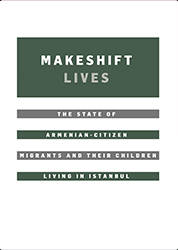
- Makeshift Lives: The State of Armenian-Citizen Migrants and Their Children Living in Istanbul
- ISBN
- 9786058165762
- Price
- Free
- Number of pages
- 152
- Language
- English
- Authors
- Emre Erdoğan & Pınar Uyan Semerci
- Design
- Sera Dink
- Graphics application
- Selin Kalkan
This research was commissioned by the Armenia-Turkey Expert Dialogue Group, convened by the Hrant Dink Foundation in cooperation with the Berghof Foundation thanks to the support of the German Federal Foreign Office and the Chrest Foundation, as part of its mandate and work towards preparing a list of confidence building measures aiming at the normalisation of relations between the two neighbours.
- INTRODUCTION BY HRANT DINK FOUNDATION 9
- ASAF SAVAŞ AKAT 11
- ARA GHAZARYAN 13
- EXECUTIVE SUMMARY 15
- INTRODUCTION 25
- Methodology 30
- ARMENIAN-CITIZEN MIGRANTS - FINDINGS OF THE ADULT QUESTIONNAIRE 35
- Household Data 37
- Life Assessment 42
- Experiences in Turkey 43
- Life in Armenia 55
- Employment Status 58
- Living Standards 67
- Life at Home 74
- Children's Situation 82
- Social Environment and Safety 86
- Health Situation 90
- Relations with Turkey and People from Turkey 94
- THE STATE OF ARMENIAN MIGRANTS' CHILDREN - CHILDREN'S QUESTIONNAIRE 99
- Findings for the 8-11 Age Group 101
- Life in the Neighbourhood 106
- Assessment of Financial Situation 111
- Assessment of Subjective Situations 116
- Findings for the 12-18 Age Group 119
- Relations with the Family 121
- Assessments Relating to the House and Neighbourhood 123
- Assessments of Relations with Friends 125
- Assessments of School Life 127
- Assessments About the Neighbourhood 134
- Self-Assessments 136
- Satisfaction with Material Conditions 137
- Assesments About Life 142
- CONCLUSION 147
| File |
|---|
 Makeshift Lives Makeshift Lives |