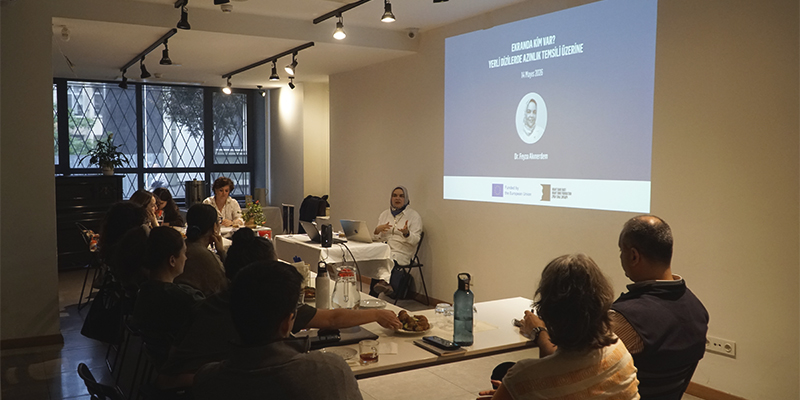
As part of the HDV Minority Rights Academy, a workshop titled “Who Is on Screen? Minority Representation in Turkish TV Series” was held on 14 May 2026 and facilitated by Dr. Feyza Akınerdem. The workshop explored how Turkish television series function as important cultural spaces in which social identities, senses of belonging, and differences are represented and negotiated.
The first part of the workshop focused on the historical transformation of television broadcasting in Turkey. Participants discussed how, during the era of state monopoly broadcasting, television served as a tool for educating citizens and constructing a shared national identity, and how, with the expansion of private broadcasting, audiences gradually came to be viewed less as citizens to be educated and more as consumers. The impact of this shift on television narratives and forms of representation was also examined.
The workshop further explored the roles television dramas have played during different political periods in Turkey. Participants analyzed how television series have reflected prevailing political agendas, which themes they have foregrounded, which identities they have rendered visible, and how they have reproduced particular narrative frameworks through selected examples.
Participants also discussed how “normative” identities are constructed in Turkish television series and the ways in which characters representing ethnic, religious, and political diversity are positioned within narrative boundaries. Examples of stereotypical portrayals, marginalization, and the limited visibility of minority and other social groups were examined from a critical perspective.
Facilitated by Dr. Feyza Akınerdem, the workshop provided participants with a space to reflect on the social impact of television dramas and to reconsider the relationship between on-screen representations and everyday life.