
Photos: Deniz Ezgi Sürek
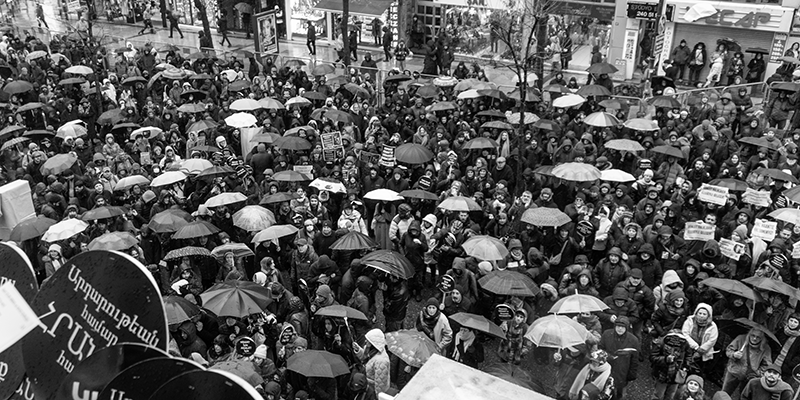
Hrant Dink, who was assassinated 19 years ago in front of Sebat Building, where Agos Newspaper's former office was located, was commemorated by hundreds of people on Monday, January 19 at 3:00 PM.
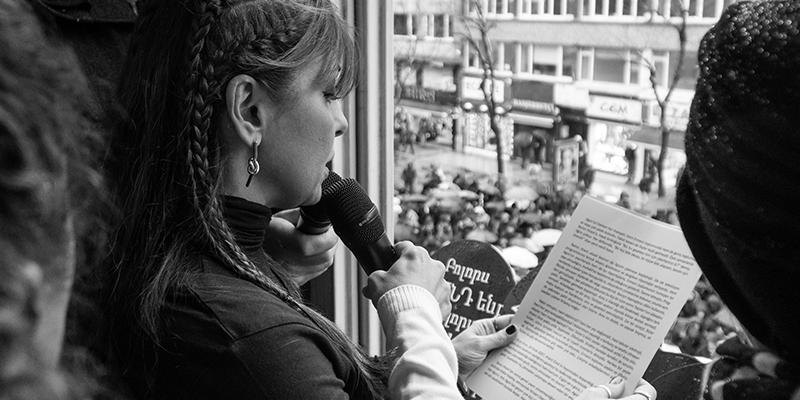
At the commemoration, where the call for justice was raised once again, this year's speech was delivered by Leda Özber, deputy editor-in-chief and visual director of AGOS newspaper.
In her speech, Leda Özber described her colleague Hrant Dink with these words: "Almost every Agos headline resonated, to varying degrees, both within the Armenian community as well as in the wider society. However, there were moments when there was no reaction at all. During those times, I would often say to Baron Hrant in disappointment, ‘Who are we publishing this newspaper for, anyway?’ Each time, he would reply: ‘Even if only one person reads it, even if I reach out to just one person, it is worth the effort for me’.'"
At the commemoration, a letter sent from Bakırköy Prison by Çiğdem Mater of the Friends of Hrant was also read. In the letter read by writer Gaye Boralıoğlu, also from the Friends of Hrant, Çiğdem Mater stated: “Once again, I lean on your strength. Despite the complicity that comes with silence, we have no right to fall into despair; we shall continue with hope. Today is the day when that hope painfully reminds us of itself. No matter where we are, behind bars or in exile, our hearts and our minds are right here, with this very hope.”
The message sent by Osman Kavala of the Friends of Hrant, who has been detained since November 2017, was read by cartoonist Kemal Gökhan Gürses, also from the Friends of Hrant. In his letter, Kavala shared: "Hrant’s ideas, his personal qualities that left a profound impact on us, and the enduring voice of Agos, which he founded and which has remained vital for the past thirty years, have been a true compass for all of us who advocate for coming to terms with the past in a just manner, who strive for a future in which children are not turned into killers, and who demand justice for all."
The elected Mayor of Şişli Resul Emrah Şahan and Deputy Mayor of Şişli Ebru Özdemir sent letters from Marmara Prison (formerly known as Silivri Prison). Resul Emrah Şahan sent his greetings with the words, "I am right there with you, dear friends, as you gather every year in defiance of rage, enmity, death, and war, united by feelings of fraternity." while Ebru Özdemir said, "You taught us the language not of fear, but of conscience. You showed us that truth cannot be carried without paying a price.” and reiterated the demand for justice.
The ceremony, broadcast live in Turkish and English online, was followed by hundreds of people. You can access the live broadcast video of the commemoration ceremony here.
Leda Özber's address:
"I salute you all from the balcony of Agos’s former office/բարեւ:
I am Leda Özber. Many of you may know me as Leda Mermer. I have dedicated my efforts to Agos for thirty uninterrupted years. This year marks the 19th anniversary of Hrant Dink being taken from us, and the 30th anniversary of the founding of Agos. I find myself in a welter of emotions, carrying deep anger and ache, alongside pride.
I would like to tell you about Hrant Dink as I knew him, and about Agos.
It was exactly 30 years ago when Baron Hrant set out to establish this newspaper together with Anna Turay, Luiz Bakar, Diran Bakar, Harutyun Şeşetyan, Sarkis Seropyan, Sandy Zurikoğlu, Setrak Davuthan, Arus Yumul, Nıver Lazoğlu, and Harut Özer. As a seasoned journalist, Anna Turay brought her experience to the endeavour; she introduced Baron Hrant to her circles from the media, and encouraged them to support him. This is how my mentor Ümit Kıvanç, Kemal Gökhan Gürses, Ender Özkahraman, and our current editor-in-chief Yetvart Danzikyan crossed paths with Agos.
The idea was to bring to life a newspaper that would put itself across in Turkish, seeking to reach a wider audience while telling its stories and voicing its concerns. My journey began when Baron Hrant invited me to join the newspaper, sparking my motivation to work in this newly emerging, vibrant environment. Before long, I found myself first typesetting and later designing pages, working alongside highly remarkable and precious individuals. Our work followed a master–apprentice tradition. Thanks to Agos, I had the chance to meet countless people, and learned an immense amount. Our workspace felt almost like an institute, featuring figures like Sarkis Seropyan, a walking encyclopedia whose knowledge could never be found in any book; Yervant Gobelyan, a prominent author whose works we studied in our literature classes at school; Rupen Mashoyan, an Armenian language specialist; Hagop Ayvaz, a legendary figure who dedicated his life to theatre… And around them were young people, some studying journalism, others, like me, keen on journalism, unable to fit within their shells, searching for venues where they could create and speak in their own voices — ‘Hay’ [Armenian] youth who did not sit comfortably with the clichés of their rather conservative community.
Under Baron Hrant’s lead, over different periods, our editorial office comprised Sarkis Seropyan, Yervant Gobelyan, Sevan Değirmenciyan, Diran and Dzovinar Lokmagözyan, Maral Dink, Lusyen Kopar (Armenian pages), Sandy Zurikyan, Karin Karakaşlı, Jaklin Çelik, Bilge Ceren Şekerciler, Talin Büyükkürkçiyan, Lora Baytar, Mayda Saris (culture and arts), my second mentor Nuran Ağan (page design), Serda Arslan, Elmon Ersaraç, Lerna Asurluoğlu, Belinda Karaca, Talin Sarraf, Sevan Ataoğlu, Bimen Zartar, Aris Nalcı, Arman Tayran, Aznif Cünün, Cahit Demir, Ardemis Şahman, Seta Çalış, Aksel Çidem, Nazmiye Güçlü, Laura Avadar, Haycan Dink, Sarkis Güreh, Arev Suna, Romina Kavak, Serena Ölmezoğlu, Vanya Uluç, Nareg Reisyan, Sevan Kazancı, Baruyr Kuyumciyan (Armenian community news / reporter / photographer), Linda Zartaroğlu, Maral Gündüz (typesetting / page design). For many years, we worked side by side, devoting our labour to pages that resonated well beyond their moment. We were all learning journalism, by doing it.
Baron Hrant was the driving force of this team. He filled every space he entered with energy. He lived his emotions to the fullest; he expressed his anger and his love without restraint, in his unique way. Once he flung his shoe at a reporter who went out on a story unprepared; and once he rolled an editor who had published an inaccurate report all the way out of the building, chair included. One of the qualities I admire most in him was his unwavering support for the women’s struggle; women have always played a decisive role in Agos, thanks to the structure he built. Many women, including reporters, cooks, accountants, managing editors, graphic designers, and columnists have contributed their labour, and shaped both our working environment as well as our editorial line. Agos has profoundly impacted the lives of many women, including myself. For some, it served as a stepping stone in their professional journey; for others it has become a home.
When Agos first began publishing, the internet was not widespread, and accessing information was difficult. There were very few Turkish-language books and articles available on Armenian history and culture, including original and translated works. That’s why Baron Hrant had always strived to help everyone, he placed great importance on this endeavour. Many people came to visit him, including those questioning their past, researching their family backgrounds, those who had discovered their Armenian roots, and those seeking to learn about Armenian identity and culture.
By the late 1990s, we were no longer merely publishing a newspaper. Under Baron Hrant’s lead, we were closely engaged with and supporting academics, researchers, and students interested in the Armenian community, language, culture, and arts. As well as those searching for their relatives from whom they had been separated due to what had happened in 1915 and its aftermath…We had become a kind of solidarity centre. Baron Hrant was the leader of our small Agos community, which lended itself to supporting everyone who spoke the language of peace and defended living together with our differences.
Founded in 1993 with Hrant Dink among its founders, Aras Publishing was like a sister institution to us. On this occasion, I would like to remember Yetvart Tovmasyan, everyone’s beloved ‘Tomo ahparig’, whom we lost last year and who was key in giving life to Aras. Just like Baron Hrant, he was a unique person, radiating energy and vitality to everyone around him.
Another cause that Baron Hrant deeply cared about was the shared cultural and musical heritage of Anatolia. Together with Sarkis Seropyan, Baron Hrant always maintained close ties with our ‘siblings’ Kardeş Türküler, who this year celebrate their 32nd anniversary of singing in Turkish, Kurdish, Armenian, Georgian, Circassian, Laz and many other native tongues.
Turkey-Armenia relations, and its coverage, were Baron Hrant’s foremost priority.
He did put his heart and soul for the opening of the sealed Turkey-Armenia border. He wrote articles, reported stories, and raised the issue every time he met politicians. The opening of the sealed border, and the coming together of peoples of Turkey and Armenia, were among his greatest dreams. He had always imagined dancing the halay with the novelist Mehmed Uzun on the day the border opened. It never happened.
Almost every Agos headline resonated, to varying degrees, both within the Armenian community as well as in the wider society. However, there were moments when there was no reaction at all. During those times, I would often say to Baron Hrant in disappointment, ‘Who are we publishing this newspaper for, anyway?’ Each time, he would reply: ‘Even if only one person reads it, even if I reach out to just one person, it is worth the effort for me’.
Baron Hrant had begun to attract the attention of national media as well. He frequently appeared on televised debates, and gave interviews to newspapers and magazines. Through the work of Agos and through these interviews, he showed that the Armenian community was not homogeneous, and that it also contained dissenting voices. He became widely known. He spoke with such sincerity and eloquence that his words touched people’s hearts, and earned the respect even from those who disagreed with him. He spoke the unifying, bonding language of peace; he was a visionary. And so, as he found his way into people’s hearts, he attracted the attention of ‘some’. He started receiving threats. Yet, he never gave up the language he believed in, and he never gave up on his [home]land. Apart from his friends and a handful of intellectuals of Turkey, no one stood by him. In fact, both the [Armenian] community and the Patriarchate isolated him and the newspaper. It was a painful period. And we witnessed everything as it unfolded. But it seems that whatever we said or did was futile. The arrow had already left the bow.
How had it happened? How could it have happened? Weren’t we told that everything had changed — that taboos had been broken, that we could now speak about everything? The horrific and irreparable events our ancestors had to endure. Weren’t they supposed to be a thing of the past now? Weren’t bad things no longer supposed to happen to ‘us’? Yet, it happened. Hrant Dink was gone. We were stunned. We were full of rage. I was surrounded by conscientious and well-meaning people who felt responsible in some way and were filled with shame. Everyone wanted to do something, to contribute to the newspaper. The Armenian community was in dismay and rage. Afterwards, many people emigrated. More than half of my colleagues joined that wave of departure.
19 years ago, on 19 January 2007, on that dark day when Hrant Dink was taken from us all…That week, we printed a second edition of the newspaper. I remember standing on this very balcony, holding the reprinted newspaper in our hands, as we looked down at the incredible masses that gathered. That day and night passed in a haze of trying to comprehend what had happened. Then came the struggle to keep Agos alive—the most precious thing left in our hands. A few of us stayed inside the newspaper office, working without leaving the building.
After Baron Hrant, taking on the responsibility of editor-in-chief, Etyen Mahçupyan, then Rober Koptaş, and later Yetvart Danzikyan, have contributed immensely to Agos during difficult times. So many people have passed through Agos along the way. I so much wish that I could name every single person who put their efforts into Agos. They are always in my heart and mind.
On the day of the funeral, as tens of thousands of people from all walks of life marched in silence, in solemn grief, we were right here upstairs at the Agos office, struggling to prepare a special issue for Hrant Dink. I still vividly remember the words of the photographer Antoine Agoudjian as he watched the masses: ‘All these Turks — are they marching for an Armenian?’
Yes, Baron Hrant, even with your funeral you broke taboos. Tens of thousands of people, from all walks of life, came together for you and marched in silence.
I often tell my nine-year-old daughter Lea about your love of peace. We frequently visit our former office, whose balcony I am standing on today. This space has now become 23.5 Hrant Dink Site of Memory. Together with my daughter, we visit your room, preserved intact, as well as other rooms. She leaves her colourful fingerprints on the mirror artist Sarkis installed for children. If it were not for this site, how could I possibly tell your story to my daughter? Now, every time we visit the site of memory, she writes notes and leaves them for you. She is so curious about you, and keeps asking questions about you. She misses you dearly as if you were the grandfather she never met.
Baron Hrant, I would like to dedicate to you verses from the poem 'Oil' by my beloved poet Zahrad, whom I had the privilege to work with, and whom we lost shortly after you. As translated by Agos illustrator Ohannes Şaşkal:
You are all sea — stormy and vast —
I am inside that sea
I am inside that sea, a drop of oil
Adrift and alien
I am a drop of oil
Dream-soaked — on the surface of the wave —
You are all — stormy and vast —
The sea is inside my heart
Before I conclude, I would like to say a few words about the devastating realities of the world we live in today.
In Turkey, pressure on the press has been mounting. So many journalists are behind bars. Every other day, another is detained, tried, and arrested simply for doing their job, practicing journalism. Journalism is not a crime.
Even if our friends are unlawfully jailed, even if humanity is once again being uprooted from Gaza without sparing women and children, even if states once again remain silent and become mere spectators in the face of these atrocities we know all too well, we shall not give up on demanding justice, we shall never give up on raising our voice against the usurpation of our rights, and defending a humane, dignified life and co-existence.
Thank you all / շնորհակալութիւններ։”
Translation: Burcu Becermen
On the evenings of January 18 and 19, a video titled "The Heart of Reason" by Ohannes Şaşkal, an illustrator from AGOS newspaper, was projected on the exterior facade of Sebat Building in memory of Hrant Dink.
The projections made in memory of Hrant Dink since 2019 were prepared by Ümit Kıvanç between 2019-2023, by Hale Tenger in 2024, and by Memed Erdener in 2025.